Harp
Psalmist king—stringed instrument held vertically or across lap.
Old Testament
King David
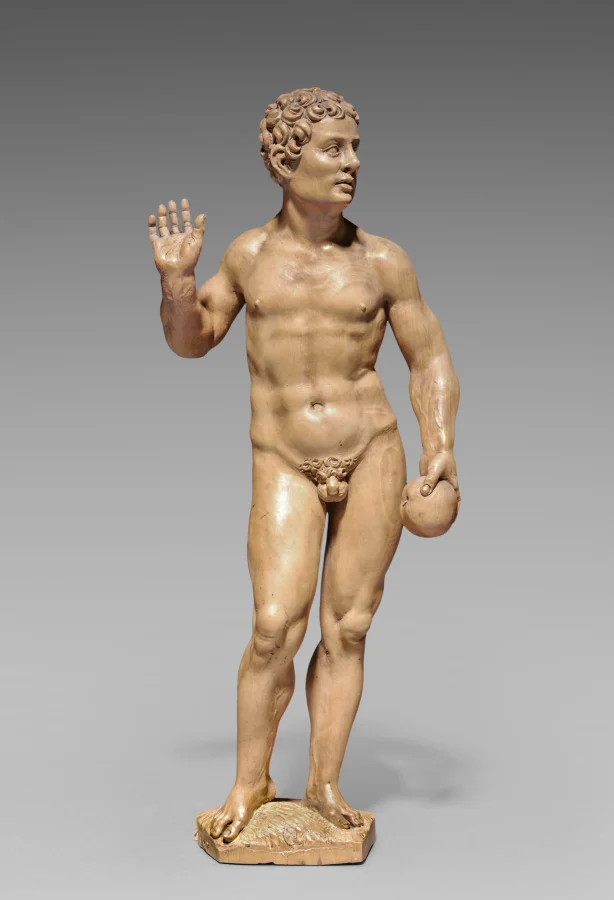
David is the king of Israel whose rise is narrated in the books of Samuel. Art presents different stages of his life: Goliath’s young conqueror, a ruler, or a musician associated with the tradition of the Psalms.
In 1 Samuel 17, David brings down Goliath with a stone from his sling and then uses his opponent’s sword. This explains two objects that may appear separately: the sling recalls the combat and the sword its outcome.
Second Samuel 5 presents his recognition as king and his establishment in Jerusalem. A crown belongs to that aspect of his story but is unnecessary in images of the youthful confrontation. Age and context change his attributes.
How does Caravaggio’s Vienna David show that the fight is already over?
The young man holds Goliath’s head by the hair and rests a sword on his shoulder. His opponent is no longer confronting him. The composition shows the result of the action, not the moment of throwing the stone.
Psalmist king—stringed instrument held vertically or across lap.
Goliath’s sword or royal scepter-like blade in victory scenes.
4 of 4 works
The account includes both objects: the stone brings Goliath down, and David then uses the giant’s sword. A painter may choose either stage of the story.
No. Many works show his youth before his reign. Conversely, a crown alone cannot identify David: numerous biblical kings share that sign of authority.
Reviewed on