The 12 Apostles: Names and Symbols in Art
Find the names of the Twelve and the clues that distinguish them in paintings. See why Matthias and Paul also appear in many sets of apostles.
Look up the Twelve Apostles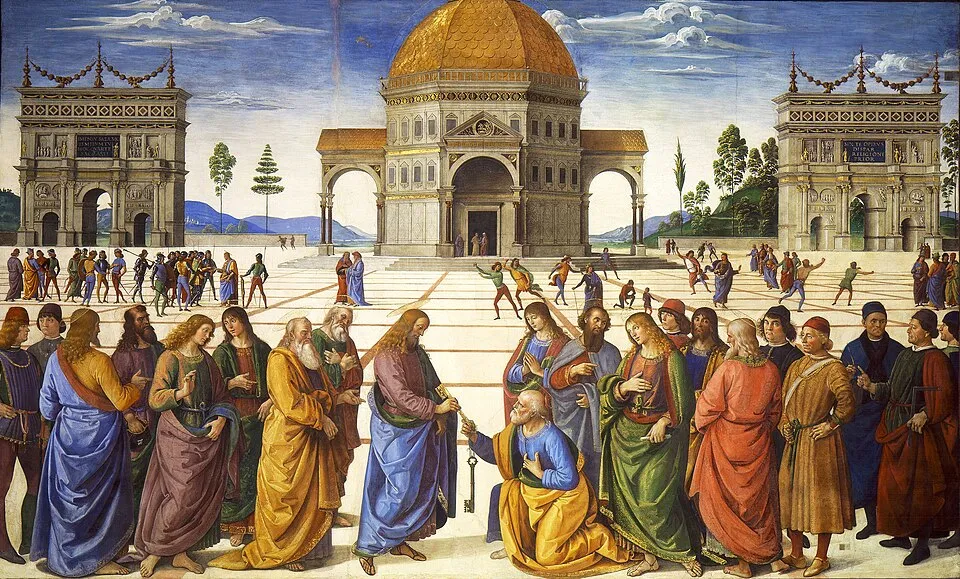
How to recognise the apostles in a painting
To recognise the apostles in a painting, start with objects and actions. Keys point towards Peter; an X-shaped cross towards Andrew; a knife towards Bartholomew. Then test the clue against the whole picture. No list of symbols replaces looking at the particular work.
A portrait in an apostle series often presents the figure with an attribute. A narrative scene works differently: notice who receives something, who asks a question and where people are looking. In Perugino’s Delivery of the Keys, shown above, Peter kneels before Christ. The act of handing over the keys places the object within a story. Vatican Museums.
First describe what you see without names: “a figure holds two keys”. Then form a hypothesis: “this may be Peter”. Finally, look for a second piece of evidence or consult the catalogue.
Who were the 12 apostles of Jesus?
Matthew lists Peter, Andrew, James the Greater and John, Philip and Bartholomew, Thomas and Matthew, James the Less, Thaddeus, Simon and Judas Iscariot among the Twelve. Matthew 10:2–4.
Simon in this list is also known as Simon the Zealot. Tradition calls the apostle Jude Thaddeus, combining Matthew’s Thaddeus with Luke’s Judas of James. The table uses names commonly found in Western art catalogues. Variations in the names.
| Apostle | What to look for | What to check |
|---|---|---|
| Peter | Keys; often a book.Source ↗ | Look for the keys in his hands or beside him. A book alone does not distinguish him. |
| Andrew | An X-shaped cross; also a fish or net.Source ↗ | The cross may be absent. In a fishing scene, check who is with him. |
| James the Greater | A pilgrim’s staff and scallop shell.Source ↗ | A hat and gourd may complete the outfit. Keep the two apostles named James distinct. |
| John the Evangelist | An eagle; in other works, a chalice.Source ↗ | In scenes with Christ, neither may appear. A youthful face is a secondary clue. |
| Philip | A cross or cross-topped staff.Source ↗ | The cross’s shape and his place in the series help. A generic cross is not conclusive. |
| Bartholomew | A knife; sometimes flayed skin.Source ↗ | In a quiet portrait, the knife may be small. Examine the hands before ruling him out. |
| Matthew | A winged human figure, book and writing.Source ↗ | He is both apostle and evangelist. The winged companion is more specific than the book. |
| Thomas | A set square; he may also carry a spear.Source ↗ | If he touches Christ’s wound, the action is decisive. An isolated spear allows other readings. |
| James the Less | A martyrdom club.Source ↗ | It can resemble Jude’s attribute. Look for an inscription or the record of the complete series. |
| Simon the Zealot | A saw.Source ↗ | Look for the toothed edge, which can resemble a sword at a small scale. |
| Jude Thaddeus | A club in some series.Source ↗ | He is not Judas Iscariot. A written name helps when another saint shares the object. |
| Judas Iscariot | His role at the Supper or the arrest.Source ↗ | His position changes between artists: no one seat identifies him in every Last Supper. |
Who replaced Judas, and why does Paul appear?
Not every group of apostles represents the same moment. According to Acts 1, Matthias was chosen to take Judas Iscariot’s place. It therefore helps to distinguish a Last Supper from a later apostle series. An axe or halberd may appear with Matthias, although neither is present in every depiction. National Gallery: Matthias.
Paul also appears in many apostolic ensembles, but he was not one of the twelve during Jesus’s public ministry. If he is present, do not force the names to fit a memorised list: consult the title and the original arrangement. To recognise him alongside Peter, use our visual comparison of Peter and Paul.
Apostles’ attributes in two paintings
Andrew and Thomas in a painting by Bernini
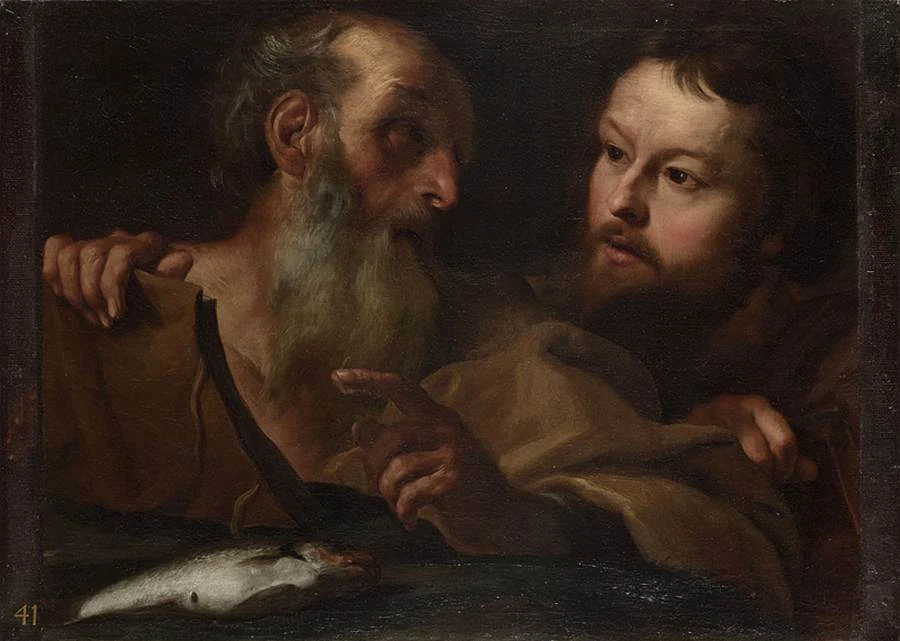
In this painting, the fish on the ledge helps identify Andrew and the set square identifies Thomas. Look at the objects in the figures’ hands and in the foreground, then check the title in the museum’s catalogue. National Gallery catalogue entry.
A spear that does not settle the identity
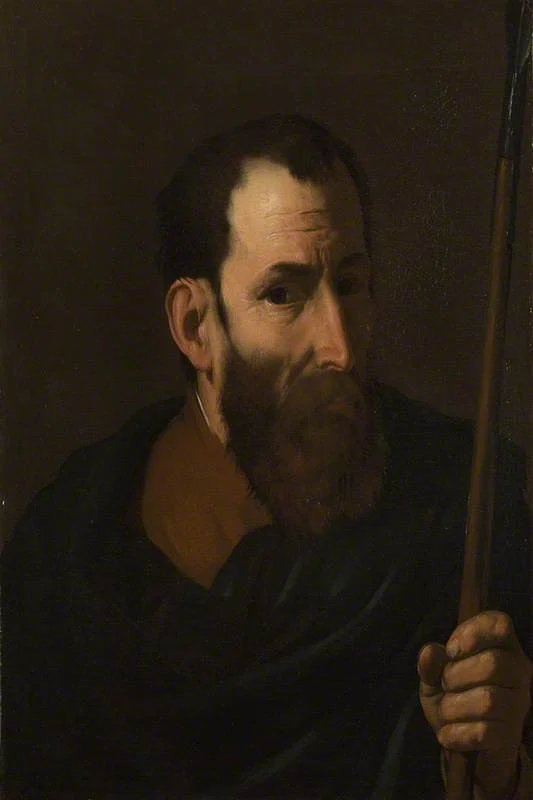
The National Gallery titles this Ribera painting An Apostle: the spear suggests either Thomas or Matthias. The cautious title is part of what is known about the work. An open identification is not a failure of observation when the evidence cannot settle the choice. The museum’s explanation.
Practise without memorising just one image
Choose an apostle and compare two works from different periods. Note which clue remains, which disappears and which depends on the scene. Repeat without reading the title. If you only remember a face or a robe colour, try another reproduction to check that you recognise the figure rather than just that painting.
You can follow a structured sequence in the course on recognising the apostles, or broaden your approach with the guide to identifying saints by their attributes.