Sword
Marks beheading at Tre Fontane (Roman tradition) and, in allegorical readings, the living Word. Do not confuse with military saints who wear armor without books.
Apostles
Saul of Tarsus
Saint Paul was a first-century Christian preacher and letter writer. His mission was especially directed towards Gentiles, meaning people who were not Jewish. He did not belong to the original group of the Twelve.
In Galatians, Paul speaks in his own voice: he recalls persecuting the Church and explains his calling as a revelation of Jesus Christ. This letter provides a different kind of testimony from the narratives in Acts. Reading both sources prevents his whole life from becoming a single conversion scene.
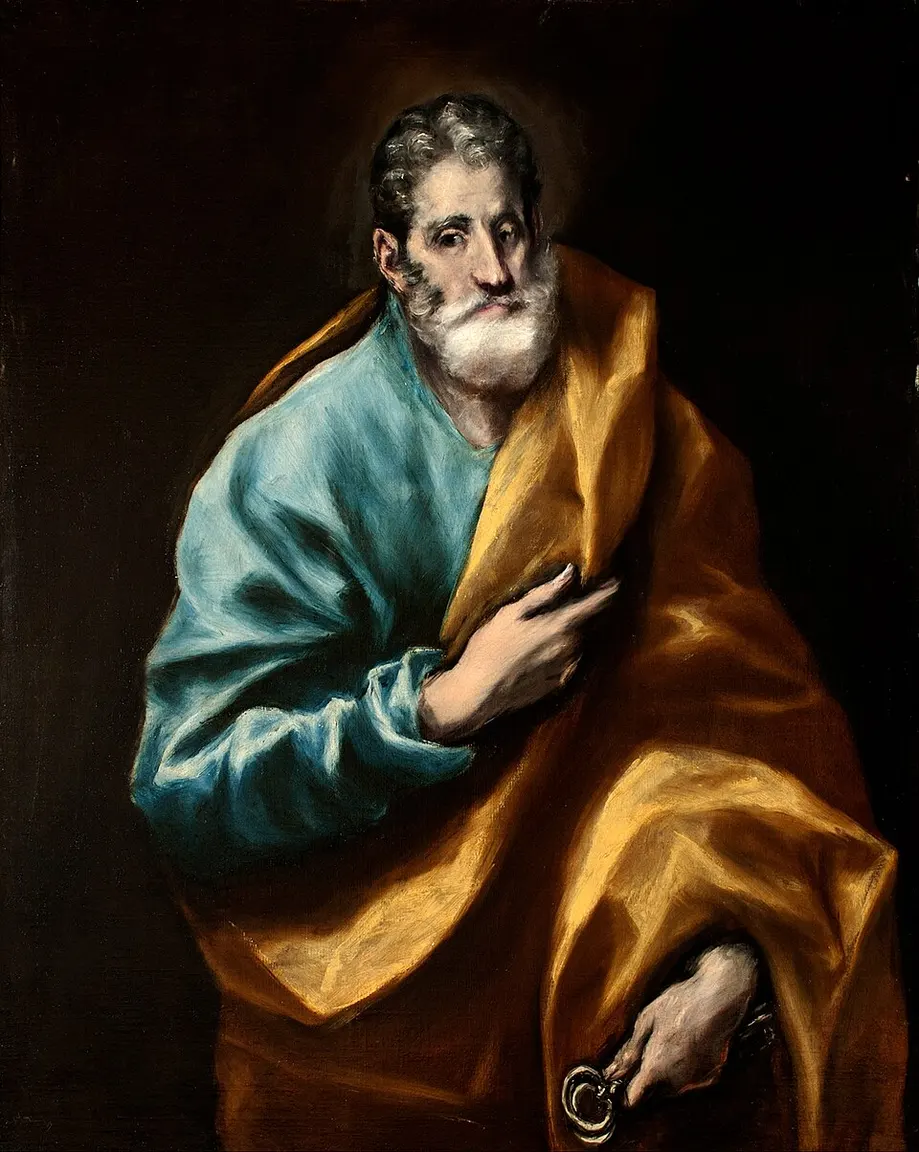
Artists condense his identity into writing and a sword. Letters refer to his teaching; the sword is associated with his martyrdom in artistic tradition. El Greco includes him in his apostle series despite his absence from the original Twelve: a painted apostolado can express a devotional selection as well as a biblical list.
Look at the illuminated object between Paul’s hands in El Greco’s painting. Is it an open book? What other shape rises beside it?
He holds a small sheet of writing, rather than a large open volume. A long, upright sword appears to our left. The combination of correspondence and weapon distinguishes this image; neither the dark beard nor the reddish cloak identifies Paul on its own.
Marks beheading at Tre Fontane (Roman tradition) and, in allegorical readings, the living Word. Do not confuse with military saints who wear armor without books.
Represents the Pauline corpus—sometimes open to Romans or Corinthians in humanist altarpieces.
Earlier or Byzantine forms prefer scrolls to codices; same theological meaning as the book.
6 of 6 works
Acts does not describe such a change. At 13:9 it introduces Saul as someone also known as Paul, well after the conversion account. Treating them as two names of the same man follows the text more closely than claiming that Jesus renamed him.
Paul calls himself an apostle at the beginning of Galatians, grounding his mission in Jesus Christ. An apostle and a member of the original Twelve are not identical categories. Artistic series, including El Greco’s, can include him because of the significance of that mission.
Reviewed on