Winged Ox
The ox or calf, often winged, is the emblem of Luke in groups of the four evangelists.
New Testament
Saint Luke the Evangelist
Luke is the evangelist to whom tradition attributes the third Gospel and the Acts of the Apostles. He does not belong to the group of the Twelve.
Iconographic Attributes
Ancient tradition identifies him with Luke, the physician associated with Paul. The Gospel’s prologue distinguishes its author from the first witnesses: it presents an investigation based on accounts passed down by those who saw the events.
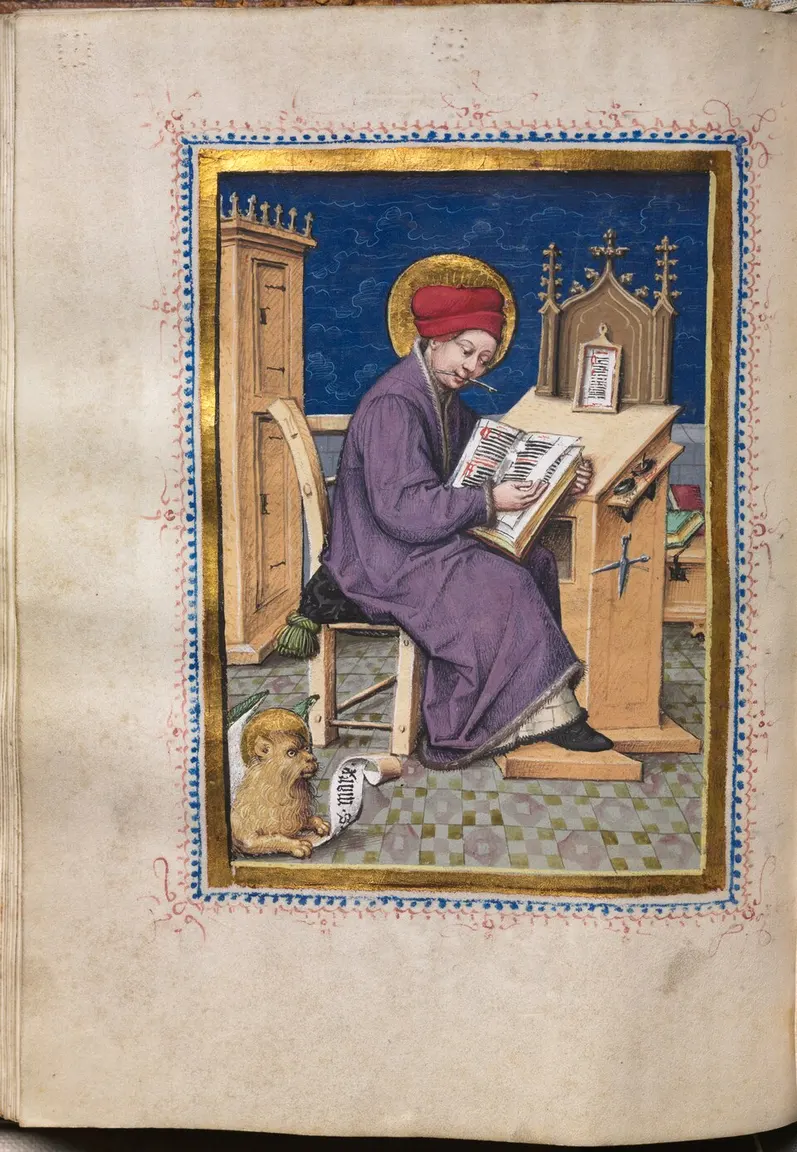
The Gospel and Acts form a work in two parts, dedicated to Theophilus. The first tells the life of Jesus; the second follows the expansion of the Christian community. In evangelist portraits, the act of writing makes this transmission of narrative and teaching visible.
Find the animal beside the desk. Which features distinguish it from Mark’s lion?
Its bovine head and horns identify it as an ox, even though it also has wings. The Housebook Master’s miniature places Luke among his books and writing tools. The animal identifies the evangelist within that shared setting.
The ox or calf, often winged, is the emblem of Luke in groups of the four evangelists.
Gospel and Acts—often two books or thick codex.
Divine or sanctified light around the head
Garments of the Twelve or evangelists
4 of 4 works
No. Being an evangelist does not mean belonging to the Twelve. His Gospel’s prologue refers to accounts received from the first witnesses rather than presenting him as one of them.
They are the two parts of a single narrative project, traditionally attributed to Luke. The story continues from Jesus’s life to the spread of his message through the earliest communities.
Reviewed on