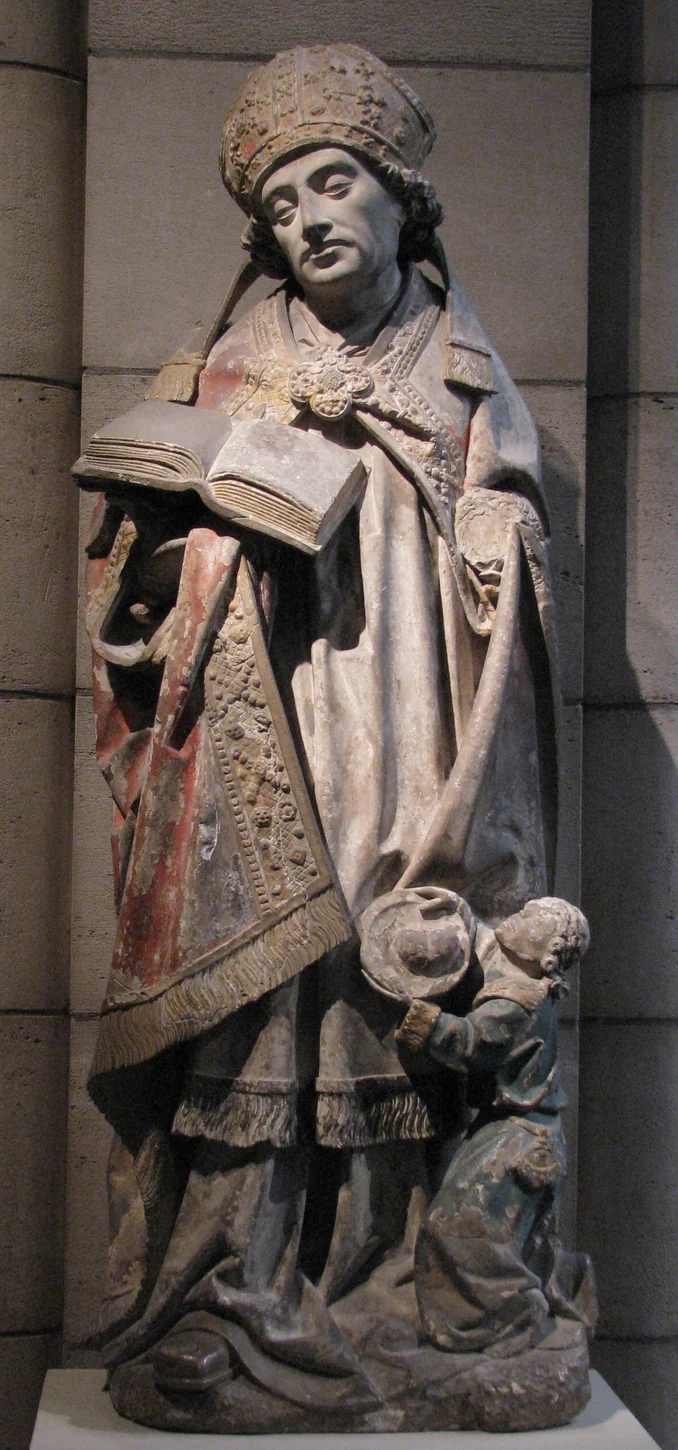
Mitre
A pointed liturgical headdress. It indicates rank and can be shared by several saints.
Saints
Ambrose of Milan
Saint Ambrose was Bishop of Milan in the late fourth century. He is remembered for his preaching, his writings and his influence on Augustine.
Ambrose held a Roman civil office when he was chosen as bishop in 374. The role drew him into theological debates and brought him into contact with the rulers of an imperial city. His preaching was important in Augustine’s path to baptism.
In the Western tradition he is one of the great Latin Doctors of the Church, with Jerome, Augustine and Gregory the Great. In series of portraits the mitre and book convey his roles. Milanese coinage also depicts him on horseback, raising a scourge.
What details in Goya’s painting can you use to describe the figure before identifying him?
The mitre suggests a bishop and the open book presents him as a writer. Several Doctors of the Church share those clues. The catalogue record and the series to which the painting belongs establish that he is Ambrose.
A pointed liturgical headdress. It indicates rank and can be shared by several saints.
A crook carried by a bishop or abbot. Read it alongside the vestments and any personal attribute.
Gospels, doctrine, or wisdom
A whip can identify Ambrose when paired with episcopal dress, or signify penance in other contexts.
4 of 4 works
December 7, the date associated with his episcopal ordination. The feast commemorates his work as a bishop, writer and preacher in Milan.
The rider with a raised scourge identifies the city’s patron. The coin links Ambrose with Milan in a civic setting, distinct from portraits that show him as a writer with a mitre and book.
Reviewed on